Wednesday, September 28, 2011

FORMSPRING: SADDEST MOVIE?

Ever cry after waking up? Is that residual sadness from having left a happy place? Is it a little of your soul leaking out of your eyes? Or am I just grasping at straws here a bit?

Yeah, probably that last one.

Here's Josh again with the third of the four questions he asked.

JOSHUATHEANARCHIST asked - What movie made you cry the hardest?
I get emotionally invested in some of the weirdest films. Motion pictures that would be greeted with dismissal or scorn by the majority of my peers will sometimes tug at my heartstrings. 'Freddy Got Fingered' I can least account for.

Forget "You had me at 'Hello'.", I actually got a lump in my throat over "All I want to do is suck your cock!". Ironic, of course, because that particular scene was intended as mockery of those types of moments.

Hey, I didn't say I could explain it.

But as far as the most emotionally devastating, I’ll have to go with a documentary by the name of 'Dear Zachary: A Letter to a son About his Father'.

'Dear Zachary' is set up as a video account to the son about his father who was killed before Zachary was born. Here’s the kicker, though; the prime suspect in the murder is the man’s fiance. Worse still, the man’s parents are put in the position of having to keep a civil relationship with the woman who most likely killed their only son in order to have a presence in their grandchild’s life.

It’s a documentary with no pretense of objectivity; the film is by a childhood friend of the victim who used the process of making the film to work through his grief. Despite that, the final impression is one of optimism.

So yeah... my knees nearly buckled out from under me while watching this film.

Oh, and unlike 'Freddy Got Fingered', this is a film I'd actually recommend. Highly.

Tuesday, September 27, 2011

FORMSPRING: DREAM CROSSOVER?

Ladies and gentlemen, the continuing misappropriation of the Formspring medium as an excuse to write impromptu articles about subjects which already interest me! Trust me, it's not as pretentious as it sounds.

JOSHUATHEANARCHIST asked -
What is your dream crossover?


Crossovers are hard to do right even assuming the right intellectual properties. There have been some brilliant examples of successful crossovers to be sure, but it’s always a balancing act. So first let's look at three examples of crossovers which I consider to be successful and why they work.

CROSSOVER SUCCESS STORY #1 – FREDDY VS. JASON
Because of the significance of these respective franchises and their respective roles in 1980’s Slasher-Horror, it seems like a no-brainer to do a cross-over between these two characters, but this was a project that languished for over a decade in development hell. The biggest challenge, of course, was how in the holy f*ck do you get an undead mindless killing machine and a non-physical child killer together in the same movie... and make it feel like a natural addition to both series?!

The solution was quite eloquent: symmetry through fear imagery. Freddy’s afraid of fire, the writers figure, because he burned to death. Jason of water. After that they simply structured the film around three fights between Freddy and Jason (one in the dream realm, one with Freddy possessing someone, and the final with Freddy manifested in the real world). Suddenly they had a solid little movie that worked as a gloriously sleazy tribute to both franchises.

CROSSOVER SUCCESS STORY #2 – SEVEN-PER-CENT SOLUTION
Sigmund Freud meets Sherlock Holmes. The idea is so ludicrously awesome. It shouldn’t gel together, but it does. Again the question; how can these two seemingly contradictive powerhouses of deductive reasoning, one of criminology and one of the mind, be placed into the same world?

The crazy glue that joined these two was cocaine. The increasingly neurotic and paranoid master detective was addicted. Unlike today, Cocaine in the late 1800s was thought of as no more harmful than Asprin and there actually are references in the Doyle stories of Mr. Holmes indulging in the substance. For the purposes of the story Freud opposed the drug and comes to treat Holmes in the story.

And it wouldn’t be a proper Sherlock Holmes yarn without a mystery; that mystery becomes a part of the good doctor’s treatment.

As a side note; the author also has writing credits on Star Trek II and VI, considered the best of the film series and my personal favourites as well.

CROSSOVER SUCCESS STORY #3 – BATMAN: DEAD END
And finally a fan-made film from a few years ago which features a crossover between Batman and the Predator franchise (with touches of Alien thrown in for good measure). This time there’s little attempt to give story to bridge the two characters and franchises (Why are there Xenomorphs in Gotham? How did they get there?); the film just faces Batman against a Predator. This approach can only work in a short film, but it absolutely works.

Going into it further, Predators have been characterized as being a warlike race which respected the strength of a warrior above all else. Batman certainly fits that warrior bill, so I guess even in something like this there needs to be some kind of logical connection underlying the crossover.

The tone, the story, the worlds and continuities need to be able to mesh cleanly as well. The narrative after all needs to feel like the perfect balance between the two universes. David Suzuki and Jane Goodall would work more cleanly in a fictionalized story more cleanly for this reason than Tarzan and John Lennon.

But enough stalling; my ideal crossover would be Hannibal the Cannibal and Austin Powers!

...Well, it's better than 'Sherlock Holmes meets Jurassic Park'.

Sunday, September 25, 2011

FORMSPRING: FAVORITE SPACE OPERA?

Hey all! Trenchie here again with something different. I'll be re-posting the better responses from my Formspring account here. The goal is to post a new response every couple of days. Let me know what you think!

JOSHUATHEANARCHIST asked - What's your favorite space opera?
That's a very narrow genre with not a lot of entries to draw from. Less than that even as I'd contest many of those labeled as such. Even Star Trek doesn't really fit until some of the later series. And the reverse is true of Star Wars' later-day Prequel Trilogy, which it could be argued are closer to Political Thrillers than Space Operas.

But even then, there's some excellent examples to be found. I'll freely admit to a soft spot for Titan A.E., and both Wrath of Kahn and Undiscovered Country are damn good movies by any standard.

In the end though, I'm going to have to come back to Star Wars. It's easy to forget in the current climate of Lucas-hate just how much the original film and the two which followed changed the cinematic game. The editing choice in New Hope to craft around the rhythm of the story rather than to match pace with the actors' performances is a style which still informs editing choices on modern spectacle pieces. The sound design by Ben Burtt pushed the idea that sound should be as important as the visuals (not the first and not the only, but absolutely among the movement's key players). John Williams' score set a precedent still followed today. The special effects and merchandising too changed their respective disciplines.

In a very real way modern American moviemaking as we recognize it started with Star Wars. Watching with an eye to all that, it's absolutely breathtaking to see the mastery of craft present in those films.

I can't honestly say the same about any other Space Opera.

Tuesday, July 12, 2011

This Post Could Get Me Arrested

AUTHOR’S NOTE:
August 21, 2020
This was a post I wrote 9 years ago. Rereading for the first time in MANY years, the argument was flimsy even at the time of its writing. Something irked my about the case stated at the beginning and I felt compelled to spout righteous indignation at the idea of a person arrested in Canada for possession of a comic book that was legal in the USA. 

I still have no idea what the manga/hentai was that spawned this whole thing, nor do I really want to know. But the graphic novels I referenced? Yeah, none of those have ever been challenged on those grounds to my knowledge. And I’d be disingenuous if I didn’t acknowledge Japan’s more problematic relationship to sexuality. I love the art that comes out of that country, but there’s WAY too much rape in their pornography... and for god’s sake they have vending machines that sell used panties.

I’m not really in favour of censorship, even in those areas that we many not like. That’s at the core of this post. That’s the reason I haven’t taken it down in the last 9 years. Just don’t read this thinking it reflects my values, or really that it’s any good.

Recently an American was arrested at the Canadian border on charges of possession of child pornography. Now, in no uncertain words, the sexual exploitation of any child is despicable. I have no sympathy with peddlers of child pornography and less for those who participate in it's creation.
But this is different.
The child pornography in question was a digital copy of an undisclosed Manga (Japanese comic book).
And let's make this perfectly clear, the material in his possession is legal under the laws of the man's home country. This is because of the definition of child pornography differs between our two countries.
In the States child pornography is defined as being the product and record of child abuse. By definition the material can only involve real children because an artistic rendering of fictional characters, no matter how explicit, has no underlying crime or victims.
In Canada child pornography is defined as being the depiction of nudity or sexuality in anyone under 18 years of age. This depiction can be in any form whether it be photograph, painting, or illustration. Conceivably even ASCII art under theoretical extremes.
So, oh country of mine, how far does this go?
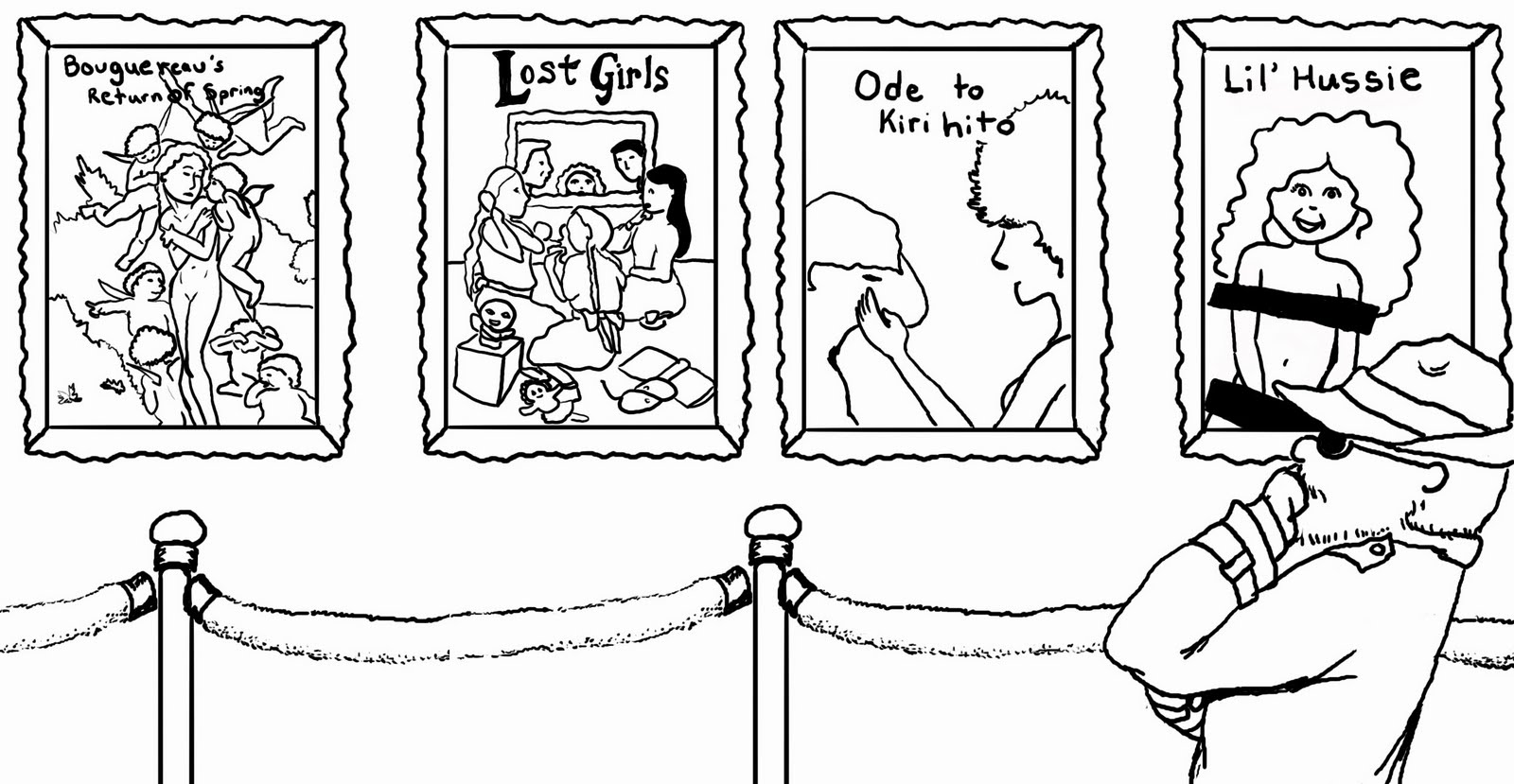
One of the seminal pieces of graphic literature in the 20th century is the Sandman series. The character of Delirium is depicted as being grade school age and often wears clothes that expose her bare chest. Is that considered child pornography?
Osamu Tezuka's Ode To Kirihito, widely considered to be the first medical thriller in manga and certainly influential, is filled with explicit female nudity. Because of the artistic style and because age often is not mentioned, someone could easily identify the illustrations as being of minors.
Oh, but let's go further, what about nude baby pictures? Illustrated medical books? Sex Education highschool textbooks?
But I think the above examples are going to be pretty safe. Let's step towards the grey area, shall we?
Let's look at Lost Girls.
Alan Moore is basically THE creative powerhouse in the world of graphic literature. Chances are that if you're even a passive fan of graphic novels, you're aware of his name and his impact on the medium.
Lost Girls is something Mr. Moore himself describes as being pornography. To be clear however, his stated intent in defining the work in such a way is not to belittle the content but to elevate what adult material can be. For those not aware, the story of Lost Girls follows Dorothy Gale, Wendy Darling and Alice meeting and sharing the sexual exploits of their younger (most certainly underage) years in retellings of their respective familiar tales.
The work contrasts their sexual exploits with the growing violence of the oncoming first world war. Much like Lady Chatterly's Lover, which set a passionate affair between an upper class married woman and a servant against a backdrop of class struggles, Lost Girls has a much richer thematic tapestry than it's plot summary would suggest.
To say that such a work has no literary value is absurd, yet I've little doubt this book would fall under Canada's definition of child pornography.
The reality is that sexuallity isn't something that just switches on at eighteen. And a person's sexual awakening is usually one of the most powerful and profound events in their lives. A first lover may stay in your mind longer than any other. The first dance, the first kiss, the first moment of shared intimacy; these are rites of passage that resonate with everyone regardless of ethicity or background. And often it's against the background of those profoundly affecting events that the strongest stories are told.
It's for that very reason that this report disturbs me.
If as a society we're unwilling to tolerate exploration of something so fundamentally human in art and graphic storytelling, then what does that say about us?
Yes, Japan is known for some pretty messed up stuff particularly in the depiction of sexuality. Yet, ironically, images of explicit sexual activities and frontal nudity were banned well into the 1980s. And rather than leading an increase, a late 1990s study found a marked decrease in sex crime across all demographics since the that ban was lifted. To quote: It is certainly clear from our data and analysis that a massive increase in available pornography in Japan has been correlated with a dramatic decrease in sexual crimes and most so among youngsters as ... victims.
But there's more at stake here, I think; if we're not willing to take a stand for the freedom of artistic expression when it challenges something we may not agree with then what right do we have to do so when it happens to be something that DOES matter to us?
Until next time, I'm the Trenchcoat Anti-Critic... and I need a shower after this.
ONE FINAL THOUGHT
In most of North America the legal age of consent is 16. Two teenagers can legally get together and screw each other's brains out on their sweet sixteen party, but God help that same couple if they engage in 'sexting'; even between a legally consenting couple, possessing a photo of a lover's exposed underage breast is a felony.
ILLUSTRATION BY BETH WAGNER

Saturday, June 18, 2011

An Interview

I'm working on something kind of cool that's eating up my time right now, so no new article this week. Instead, well, somebody interviewed me! If you follow the facebook page, this'll be nothing new, but for those who don't; enjoy!

Wednesday, June 8, 2011

Spoon Feeding Canadian Nationality

ON CANADIAN CINEMA
I love films. There's little I enjoy more than curling up with a decent movie and spending an evening swept away by a film-maker's skillful execution of a story. Very frequently I'll find myself on the opposite side of popular opinion on a movie (particularly genre entries, for some reason).

The much maligned Freddy's Dead is among my favorites of the series. Up there too is Aliens Vs. Predator. Extreme examples, of course, but I stand by them.

And conversely there are a few things which irritate me to no end that go by unnoticed by most others.

Chief among these is something I'm going to call Mandated Nationality. I won't be so conceited as to say this only happens in Canada, but it's the occurrences in Canadian productions which irk me.

Mandated Nationality happens when a Canadian film's financing depends on government grants. See, in order to qualify for these Grants, productions need to prove how Canadian they are. Influence from this ranges from requiring a percentage of key positions being Canadian to the numbers of Canadian flags needing to appear.

In the States, the process to make a movie goes like this: a producer pitches a story to people with money and convinces them to invest based on the strength of that story. It could be about a Tibeten spiritual leader, or an Indian revolutionary, or even a Russian submarine and it'd have a genuine chance of selling.*

I understand it. Honest.

Films from Canada have to compete directly with films from Hollywood. Add to the mix our lower budgets, smaller population, and shared language and it's little wonder the vast majority of Canadian films don't even break even, let alone make a profit.

So with profit realistically taken out of the equation, the motivation for funding films for organizations becomes about 'preserving cultural identity'. Or 'exploring the Canadian experience'. That translates to ensuring the stories that are told are Canadian stories; often filled to the gills with Canadian iconography.

But here's the thing; Canadians aren't interested in CANADIAN stories, they're interested in HUMAN stories.

Time for examples.

CASE STUDY - 'BON COP, BAD COP'
The idea of having a Quebec cop and an Ontario cop forced to work together is actually a clever idea. The situation is both uniquely Canadian, yet stems from human interaction. It allows the film to have a lot of interesting undercurrents related to the political and social differences between English and French Canadian cultures.

But then... the villain.

For those who haven't seen this film I'm not going to spoil it, but the villain and much of the plot revolves around something so ridiculous that it could only have come out of a bunch of people going "How can we make this movie about Ontario and Quebec detectives MORE Canadian?".

An otherwise fun film.

CASE STUDY - 'SCORE'
Hockey. The Musical. Ugh...

Bubble gum songs (with no lyricist) and a plot straight out of the 1950's musical era. This seems more of a joke of what a Canadian musical would be than a real movie, but it's played straight.

This is the only film on this list I have not seen.

CASE STUDY - 'ONE WEEK'
This is a story about a man who goes on a road trip across the country after learning he had cancer and the lives he touches on his journey.

Well, in theory.

The issue I have with this film, directed by Michael McGowan (who was also behind Score), is that the character arc doesn't ring true to me. Ultimately he's running away from his problems, and beyond deciding to undergo treatment he doesn't fundamentally change.

A better way to put it is that the whole story feels shoe-horned in as an excuse to show as many Canadian landmarks as possible. And what qualifies as a Canadian landmark? A really big chair, some statues and the Stanley Cup. It doesn't really compare with Mount Rushmore as far as iconography goes.

This movie too I'll admit to being overly harsh on. The whole thing is scored with some great tunes, it's inventive, and the narration is reminiscent of Pushing Daisies or Amalie. It is actually really enjoyable.

None of that changes how much it pisses me off, of course.

CLOSING THOUGHTS
The truly ironic thing is that these movies make such an effort to be Canadian that they end up representing little more than a steriotype of the country; they offer empty platitudes rather than saying anything new or meaningful about the Canadian experience.

It's not like movies about Canadians can't be good. Both Shake Hands With The Devil and Scott Pilgrim trump any doubts about either the variety or quality potential of our stories.

And Canadian films don't consist exclusively of Bureaucratic compromizes. Despite the hurdles, the Canadian arthouse scene is actually considered one of the most exciting in the world right now. Directors like Atom Egoyan, Guy Madden, and Deepa Metha are continuing to win near universal accolades.

And the mainstream is certainly not without quality productions, either. Films like Suck, Pachendale, and A Simple Curve are proof enough of that.

In other words, it can be done.

Until next time, I'm the Trenchcoat Anti-Critic.

NOTE: It needs to be mentioned that this article is strictly refering to English speaking Canada. Quebec has a thriving and self-contained film industry. That's a topic for another day.

*Kundun, Gandhi, and K19: The Widowmaker respectively.

Friday, June 3, 2011

Westboro Babtist Church

At this point, I think everyone is at least somewhat familiar with the controversial Westboro Babtist Church. For those who don't know them by name, you know those people holding multiple billboards reading "GOD HATES FAGS" and "THANK GOD FOR DEAD SOLDIERS"? Them.

According to wikipedia the church, which is very small I might add, spents upwards of $200,000 on travel expences in their cross-continent protesting quest at the highest profile events they can muster.

Honestly, I have a grudging respect for how effective they are at viral marketting. They've gotten millions of dollars of 'free' exposure on the news, had multiple high-profile documentaries made about them, and have become a household name to many lgbt rights activists.

The church, though it qualifies as a non-profit organization under US law, has landed on several lists of known hate organizations.

Which makes it all the more surprising when little over a week ago the Knights of the Southern Cross, a Virginian chapter of the notorious Klu Klux Klan, showed up to counter-protest the WBC's latest attention grab at the funeral of a US soldier. The organizer of the KKK's presence, a veteran himself, felt the WBC's protests at soldier funerals were deeply disrespectful.

More surprising is that the Westboro Babtist Church, which has labeled Barack Obama the Anti-Christ and have compared jewish people en mass to Nazis, claim to have nothing against people of other race. In fact, the churches founder, Fred Phelps, reportedly was involved in the civil rights movement of the '60s.

Remember when it was easy to tell who the bad guys were?

Until next time, I'm the Trenchcoat Anti-Critic.