Author's Note: This is an article I've been trying to write since I started this blog in 2009. With the recent passing of Roger Ebert, it felt appropriate to revisit and finally finish this article.
"Time mag sells its honour for a video game promotion. Sad, sad, sad." So tweeted Roger Ebert on June 13 of 2011.
The event Mr. Ebert referred to was a promotional faux Time Magazine cover created for Modern Warfare 3. It's especially significant in that Time magazine has hitherto denied the right to license their likeness in the promotion of any other product. It was unique in this respect to most or all of it's peers, as I understand it.
Ironically I actually agree with his disappointment on this issue, though for different reasons. The Modern Warfare series is basically the video game equivalent to a Michael Bay or Roland Emerich vehicle; lot's of flash and spectacle but light on social sensitivity. Time is still one of the most respectable magazines of its kind in North America and for it to lend its credibility to what amounts to sensationalist, empty entertainment just feels kind of... well, it didn't actually have any lasting effect one way of the other so it's kind a moot point. That said, I'm still not particularly impressed with Times' publisher at the time Kim Kelleher referring to MW3's demographic as "boys" (the series' largest consumer base peaks at 35, not 20).
But that's not the real issue here. At the heart of Mr. Ebert's statement was an attitude that video games are a lesser medium. Of course, this is hardly the first time he's expressed that sentiment. Since 2005 Roger Ebert maintained that games were not and could never be Art.
In his original article Mr. Ebert articulated that because the experience was shaped by the player it diluted the control of the author on that experience and so by extension diluted the authorial message/intent. Simply put because the experience is changed by player's actions, the author is rendered effectively moot.
The reaction to this has been fierce and varied, but those who's argument has been more thought out than a verbal knee-jerk reaction generally fall into two camps.
THE FIRST CAMP
Those falling here argue from their personal definition of Art. Though sometimes insightful and often well thought out, this approach is fundamentally flawed because it changes the parameters of the argument. I invariably find myself coming to the same questions: "What are YOU basing your definition ON?" and "What makes your definition more valid than Ebert's?". Remember, Roger Ebert was not an uneducated man in the realm of Art and the criticism thereof. He was the first person to win a Pulitzer for film criticism, after all.
There are several lines of thinking I find interesting, here. One argument has it that if every element of a game taken alone can be considered art than so too must the sum of those parts. This isn't too far fetched, music from Final Fantasy is held in respected concert halls and the artwork has been subject of touring museum exhibits.
Others bring up the visuals of this game or that as being proof enough of artistic merit, arguing that aesthetic appeal is enough to warrant the stamp of Art. This does actually have some legs as in the Art World prior to the modernism movement aesthetic beauty was a primary evaluator of an artwork's worth. I encourage art history buffs to correct me here on specifics and timeline; my knowledge of Art History is cursory at best.
THE SECOND CAMP
But back to the subject at hand, the second camp is far more interesting as it side-steps the whole debate to ask 'If we assume that games are art, what would that actually mean?'. The best place I've seen this was in the excellent Extra Credits, which explores the medium of games from the perspective of those who make them. I can't find the specific episode I'm looking for, but they address this subject a few times.
Again though, this doesn't really address the core argument because it also changes the parameters of the debate. It is, however, the next logical step of where to take it.
Not here though.
Here we're still talking about the argument set forth by Mr. Ebert. I've not seen any article or video address that argument
directly.
See, Ebert's definition of Art didn't come out of thin air.
The idea of the artist's voice needing to be present actually has it's
roots in Auteur Theory, which was a movement that helped settle decades
of heated debate and legitimize cinema (genre particularly) as a
legitimate form of Art.
I am well and truly late to
this party but let's see if I, as a man who's not actively* played
mainstream games since 2004 and sporadically before that, can bring
something new to this stale debate.
THE THIRD CAMP
A few years ago I had a conversation with an art major about the nature of art and video games along these lines. This conversation led to many very interesting lines of thoughts that I'd like to explore here.
Your average video game, by design, places each individual member of its audience into the role of active participant. Because of this control, each player has an experience unique to them and each play-through is equally unique. This much of Ebert's point is true, but it really applies only to the minutiae of any given gaming session because player freedom is not absolute. The player's actions are shaped by immutable parameters set by the game's author.
In God of War you can dispatch the creatures in your path only by means of a set array of attacks and the path he travels is always the same. Likewise, the player has only as many avenues of control as there are buttons on the controller. Kratos will never build a catapult or learn Scottish Country dancing or negotiate a Peace Treaty. There is no diplomacy button mapped to the controls of Master Chief just as there is no attack command in Guitar Hero. Even the most open-ended gameplay models such as World of Warcraft or Everquest shape gameplay through interactivity limitation.
In other words while games offer the illusion of control, for the vast majority of games it is (within the boundaries of standard deviation) the same or comparable experience between it's every audience member. Which means that there can indeed be a clear authorial voice in a game.
It follows then that reducing a player's choices increases that authorial voice.
This is certainly evident in many games self-identified as 'art games' that limit the player's input options. Sometimes to even a single button so as to make the experience more akin to a novel where there is only one path through which to proceed. There are many excellent Flash games which use this limited control palette to more directly explore a facet of the human condition. For example, both Loved and Everyday the Same Dream have controls simple enough to map to an Atari controller.
The idea of a limited canvas better highlighting themes and character can be found in mainstream games as well. Consider the following example: one of the most emotional moments in 90's gaming is Aries' death in Final Fantasy VII. While most people cite the cut scene in which Sephiroth dramatically drops death from above, it's the lead up that I find more interesting. Cloud, possessed by unseen forces, moves towards Aries with his sword drawn. Despite there only being one option available (move towards Aries to kill her), the player controls Cloud's every step. Any other button but forward on the d-pad did nothing except make Cloud briefly struggle. In forcing the player to take Cloud's every step it gave the possession more weight than a cut scene could ever have. In spite of Sephiroth's sword being the death blow, I question whether the moment would have cemented itself in gaming culture with as much bitter-sweet reverence without this lead-up.
Of course everything in the last paragraphs could be rebuffed as essentially saying the same thing as Ebert; that to make an artistic statement as a game's author you have to take away control from the player.
But could it be that game mechanics are exactly what cements the medium as an art form?
This takes a page out of influential film pioneer
Sergei Eisenstein who looked at the medium of film and noted that it
actually encompassed many existing art forms within it. Writing, acting,
and photography all existed separate of film, but one element, editing,
was entirely unique. Similarly, game mechanics (and specifically how
each player is allowed to interact with the game) are a wholly unique
animal to the medium of video games. So, like editing is to film, it's
interesting to consider game mechanics as an artistic tool.
EBERT AND MY JOURNEY WITH GAMES
I think it's unethical given this whole debate is framed by his words not to bring this back to Mr. Ebert.
Since first touching on the subject in a 2005 review of Doom, Roger Ebert had come back to it countless times. And while he never changed his stance, he engaged in open dialogue with those on the opposite side. In a 2010 article he gave his thoughts on both Braid and Flower. The following year, an article entitled 'Why Videogames are Indeed Art' was posted on rogerebert.com by one of his correspondents and actively promoted by Mr. Ebert.
This was two months before the Time Magazine tweet.
It's safe to assume Roger Ebert never changed his opinion. Regardless, Mr. Ebert was never dismissive of games; his criticisms of the medium were always intelligent and very well written. There was little stupid or ill-informed about his opinion. But one opinion doesn't stop the world from turning.
In March of last year, the Smithsonian American Art Museum did an exhibit entitled 'The Art of Video Games', one of the first of its kind to not simply present Art inspired by video games, but instead the games themselves as Art. This doesn't settle the subject, but it shows that the tides of opinion are swinging in the direction of Video Games. More and more games are being made every year to draw upon as examples of the medium's artistic merit, from Heavy Rain to Journey to Braid to Spec Ops: The Line. In fact, whenever there's actually been a debate on the subject more often than not those in opposition to games as art come across as woefully uninformed.
I personally think the debate will always be more interesting than any definitive answer. That said, I can't write an article like this without weighing in.
I joined this console generation expressly for the purpose of writing this article. I started playing games like Bioshock and GTA4; games much lauded for their subtext and social commentary as well as game play. After getting several hours into them, I found myself getting... bored. The more serious undertones of both games I found was undermined by the actual game play. Bioshock felt repetitive (get new weapon, shoot baddies, escort little sister, get hopelessly lost and stumble around until the next story beat activates), and in GTA4 the radio stations actually became more interesting than the missions. The infamous 'No Russian' scene in Modern Warefare 2 just left me feeling numb and unfulfilled. Shadow of the Colossus, I couldn't get past the first fight.
Further, removing cut scenes and text scrawls out of immediate consideration, I actually found the games I was playing were very ineffective at telling stories, something I'd romanticized games would be better at by function of interactivity and the larger canvas.
But there are examples where this is true.
I think of Riven, where the universe felt lived-in and so little was conveyed verbally. I think of Portal. And Journey. And Limbo.
Touching again on the idea of the auteur theory, developers like Hideo Kojima and Tim Schafer have artistic visions so strong that each could be identified by their work alone.
So yes, games can and have aspired to be Art.
Until next time, I'm the Trenchcoat Anti-Critic.
*I owned a Nintendo, then a Sega Genesis. I'd still play games at houses of friends periodically in the next two console generations and I emulated a Playstation on the computer, but I'd not buy another console or actively game until 2002 when I got an Xbox. It collected dust from 2004 to 2009 when I was intrigued enough by the games as art debate to pick up a 360 to research for this article; my perspective on the issue wasn't represented but I figured it wouldn't really do to use examples from modern games which I hadn't actually played.
Monday, May 6, 2013
Saturday, March 23, 2013
Chasing the Fringe
PRELUDE
One of the challenging aspects about writing against general opinion is that it's very easy to be painted with the same brush as your subject. People like their labels; it makes a very complicated world easier to comprehend. And there's some truth in labels certainly, but labels are imperfect by nature. Worse, when you slap one on a movement, a group of people, or even a piece of media you close avenues of debate.
And I like debate.
CHASING THE FRINGE
This article was supposed to be about My Little Pony.
I've considered writing something about the show since I saw the latest incarnation almost two years ago. There's a plethora of subject matter to explore and to write about.
About creator Lauren Faust, her successes and the circumstances surrounding the show's creation. About the surprisingly wide appeal of her creations and the implications of that appeal for the world of girl-centric children's entertainment. About the irony that in the 1990s it was more likely to find well-rounded female characters in shows aimed at boys such as Gargoyles or Batman: The Animated Series than in shows actually aimed at a young female crowd.
That's what I'd love this article to focus on, but this show has a LOT of cultural baggage.
More specifically its adult fan base, mostly male, colloquially called Bronies.
You can't wave a horse around without hitting brony hatred on the internet or some disturbing story of someone taking their fandom too far in the eyes of the general populous.
It got me thinking about a few other sub-cultures that have spent their time on the fringes.
For decades, the accompanying images for the above groups would've been considerably less flattering*. Gradually recent years has allowed these cultural sub-sets to become mainstream, or at least much closer to it. The internet has let people of shared interest to gravitate together in a way that was never before possible. And in coming together, marginalized communities suddenly have a lot more power than they've ever had to shape how they're perceived.
Geek can be sexy.
Rebellion, the height of fashion.
When was the last time you looked at The Star Wars Kid and seriously considered him to be the face of the Star Wars fandom?
In the nineties The Kid would have dominated the cultural image of the Star Wars fanboy. No need to stretch the imagination far, there were many other examples. It's human nature to take what you don't understand and put it in a box. And if that was a Warmonger (no really, that's the term), then Trekkies were anti-social man-children who bath less often than they should, as far as the cultural shorthand went. Of course this is unfair. It ignores the fundamental fact that nobody is their hobby. That underneath the plastic Clingon forehead is often Johnny Normal, who works as an accountant and grew up the third of four children.
It's not difficult to understand how a sub-culture develops; the most public example stands in for the whole. Stepping away from geek culture for a moment to the third of the above examples, Punk developed with a kind of one-up-manship attitude. Compare the music of one of the earliest punk groups The Ramones (who's name is a reference to The Beatles) to Black Flag (who's name is decidedly not) and tell me with a straight face they sound like they're from the same musical genre... Even though Black Flag followed a mere two years after The Ramones formed.
It's interesting to note that the intended purpose of another influential early group The Sex Pistols was, in part, to promote a clothing line by their manager Malcolm McLaren.
The punk rocker look itself evolved over time in tandem with the movement's sound. Newspapers would print photos of only the most extreme examples of punk rock fans. This, as you might imagine, created a skid row version of 'Keeping Up With The Jones'; a fashion arms race with a huge populous pushing to find new ways to piss off the status quo (in the process simply replacing Brand A with Brand X, if you want to be cynical about it).
The movement defined itself unilaterally with what it was against, but not really with any clear cohesion as to what it was for. Many of those who embraced those conflicting ideals did so emphatically, regardless. The extreme modes of appearance, by being featured in widely distributed newspapers, gave new fans a template of what it was to be a punk rock fan; this was what it looked like to live a lifestyle defined by the music you loved. Not going to those extremes seen in print meant that you were a poser. So get another piercing, shave your head, and buy army boots.
Strange as it may seem, the parallels drawn between the punk rock and geekier sub-cultures aren't all that outlandish. After all, the reasons people gravitate together only really vary in the details.
That's what it is to be human after all.
...
Maybe now I can get around to writing about ponies.
Until then, I'm the Trenchcoat Anti-Critic.
* I am not implying here that less flattering images don't still exist, merely that they are not the ONLY images representing said the more geeky groups of people. So while the ubiquitous Star Wars fanboy image still exists, the fan culture is larger than that. The creations of that culture can be seen and embraced by the larger community (George Lucas In Love, Troopers, et al).
One of the challenging aspects about writing against general opinion is that it's very easy to be painted with the same brush as your subject. People like their labels; it makes a very complicated world easier to comprehend. And there's some truth in labels certainly, but labels are imperfect by nature. Worse, when you slap one on a movement, a group of people, or even a piece of media you close avenues of debate.
And I like debate.
CHASING THE FRINGE
This article was supposed to be about My Little Pony.
I've considered writing something about the show since I saw the latest incarnation almost two years ago. There's a plethora of subject matter to explore and to write about.
About creator Lauren Faust, her successes and the circumstances surrounding the show's creation. About the surprisingly wide appeal of her creations and the implications of that appeal for the world of girl-centric children's entertainment. About the irony that in the 1990s it was more likely to find well-rounded female characters in shows aimed at boys such as Gargoyles or Batman: The Animated Series than in shows actually aimed at a young female crowd.
That's what I'd love this article to focus on, but this show has a LOT of cultural baggage.
More specifically its adult fan base, mostly male, colloquially called Bronies.
You can't wave a horse around without hitting brony hatred on the internet or some disturbing story of someone taking their fandom too far in the eyes of the general populous.
It got me thinking about a few other sub-cultures that have spent their time on the fringes.
WARMONGERS
PUNK
For decades, the accompanying images for the above groups would've been considerably less flattering*. Gradually recent years has allowed these cultural sub-sets to become mainstream, or at least much closer to it. The internet has let people of shared interest to gravitate together in a way that was never before possible. And in coming together, marginalized communities suddenly have a lot more power than they've ever had to shape how they're perceived.
Geek can be sexy.
Rebellion, the height of fashion.
When was the last time you looked at The Star Wars Kid and seriously considered him to be the face of the Star Wars fandom?
In the nineties The Kid would have dominated the cultural image of the Star Wars fanboy. No need to stretch the imagination far, there were many other examples. It's human nature to take what you don't understand and put it in a box. And if that was a Warmonger (no really, that's the term), then Trekkies were anti-social man-children who bath less often than they should, as far as the cultural shorthand went. Of course this is unfair. It ignores the fundamental fact that nobody is their hobby. That underneath the plastic Clingon forehead is often Johnny Normal, who works as an accountant and grew up the third of four children.
It's not difficult to understand how a sub-culture develops; the most public example stands in for the whole. Stepping away from geek culture for a moment to the third of the above examples, Punk developed with a kind of one-up-manship attitude. Compare the music of one of the earliest punk groups The Ramones (who's name is a reference to The Beatles) to Black Flag (who's name is decidedly not) and tell me with a straight face they sound like they're from the same musical genre... Even though Black Flag followed a mere two years after The Ramones formed.
It's interesting to note that the intended purpose of another influential early group The Sex Pistols was, in part, to promote a clothing line by their manager Malcolm McLaren.
The punk rocker look itself evolved over time in tandem with the movement's sound. Newspapers would print photos of only the most extreme examples of punk rock fans. This, as you might imagine, created a skid row version of 'Keeping Up With The Jones'; a fashion arms race with a huge populous pushing to find new ways to piss off the status quo (in the process simply replacing Brand A with Brand X, if you want to be cynical about it).
The movement defined itself unilaterally with what it was against, but not really with any clear cohesion as to what it was for. Many of those who embraced those conflicting ideals did so emphatically, regardless. The extreme modes of appearance, by being featured in widely distributed newspapers, gave new fans a template of what it was to be a punk rock fan; this was what it looked like to live a lifestyle defined by the music you loved. Not going to those extremes seen in print meant that you were a poser. So get another piercing, shave your head, and buy army boots.
Strange as it may seem, the parallels drawn between the punk rock and geekier sub-cultures aren't all that outlandish. After all, the reasons people gravitate together only really vary in the details.
That's what it is to be human after all.
...
Maybe now I can get around to writing about ponies.
Until then, I'm the Trenchcoat Anti-Critic.
* I am not implying here that less flattering images don't still exist, merely that they are not the ONLY images representing said the more geeky groups of people. So while the ubiquitous Star Wars fanboy image still exists, the fan culture is larger than that. The creations of that culture can be seen and embraced by the larger community (George Lucas In Love, Troopers, et al).
Labels:
chasing the fringe,
fandom,
fringe society,
geek culture,
my little pony
Friday, November 2, 2012
Reviewaverse Saga Episode 7 (Part 3)
I avoided this for a long time. Truth is, my heart just isn't into it. I don't want to put out a half-assed product, no matter what that product is. It means always pushing to go the extra mile. For this final part, I spoke to Matt about doing an audio read. Perhaps even getting Justin and Lewis in for something over Skype. I was toying about approaching an artist to create images to go along with it.
Matt never fully committed, and I didn't push the point.
I can't blame him. This Saga represents so many mixed feelings. The production was likely the most ambitious undertaking that had ever been made in the internet reviewing community at the time, and it never really received due credit or recognition.
It irks me somewhat when people dismiss his accomplishments out of hand because Matt went to film school where so many others in the community didn't. As if knowing basic shot composition somehow makes it easier to make a special effects heavy science fantasy epic. The simple truth is that Matt at times had to drag his creation kicking and screaming into the world. The filming of the Saga was very often a miserable affair. People dropped out. Friendships were stressed. Nobody was paid. Matt pushed six episodes to see the light of day through sheer force of will.
The result was an odd mix of Battlestar Galactica, Tokusastsu and reviewing. Against the odds, the Saga worked more often than it had rights to. While it requires a certain mindset going in, there is a definite charm to the lead character as well as a surprising sense of scale, urgency, and stakes.
Matt's entire team deserves credit, of course. In particular he praised collaborator Will (The Blackalgia Critic), who directed many of the episodes. It was the lack of Will's enthusiasm as much as anything else that killed Episode 7.
This needs closure.
The following, with admitted reordering and flavour text, is the original text of the treatment I pitched for the final episode. It's rough and woefully unpolished, but the story's there.
For anyone who still cares, I hope this satisfies.
REVIEWAVERSE SAGA EPISODE 7 - THE LAST HOPE
THE AUTHORIZED TREATMENT

PART THREE
It takes Cinera a moment to notice the camera is off. She considers killing the cameraman, then notices ExSied. Cinera congratulates him on his glorious return. The still silent ExSied will have nothing to do with the Triad and takes a shot at her, but Cinera dodges. Realizing she's outmatched, Cinera retreats.
Back to Linkara and the Trenchcoat Anti-Critic, who've become uneasy allies. They are ambushed by Revuer 2. A fight ensues. Trenchie, it's established, is basically tactical support, able to aid very little in actual battle. Linkara uses the device he rescued from the ship to transform into his power ranger costume. During the battle, a figure is spotted observing the battle from a distance. Trenchie's damaged and glitchy registers the presence of another reviewer. Dramatic reveal of J-dub, who joins the fray with his own transformation and briefly it seems as though the good guys may be able to win.
Dramatic reveal of Ares, now transformed into Revuer 3.
Trenchie ends up paying the price of his life, sacrificing himself to give the other two time to escape. Jew Wario and Linkara barely escape with their lives.
Ares will at some point betray Cinera, and absorb her power into himself. Then he will execute the now human Cinera.
Revuer 3 ultimately becomes the main antagonist. This serves as the strongest emotional stake for Apollo. He was the closest ally and his was the ultimate betrayal. This may not be the most satisfying conclusion to Cinera's arc, though. Maybe the ExSied confrontation should come later with him soundly defeating Cinera, all but killing her. It's too late to do that in this as that scene is in Part Two of this thing, but that ordering of events would make the most amount of narrative sense. Would've. So, uh, just imagine things happened in that order. Yeah.
Ultimately J-Dub and Linkara encounter ExSied. They are hopelessly outgunned, but using Trenchie's handheld computer they're able to restore his memory... which nearly destroys Apollo.
And it's at this point that Ares arrives.
Apollo, emotionally crippled by the weight of his actions, welcomes it when Ares shows up as he "deserves to die for what I did.". But watching J-dub and Linkara stand up and fight despite overwhelmingly outmatched Apollo realizes there is still something left worth fighting for. He stands up to Ares and the ultimate battle begins.
The end, Revuer 1 and Revuer 3's ultimate attacks end up rebounding. This has the effect of a massive explosion. When the smoke clears, neither Ares or Apollo are visible.
It's over.
Linkara and J-dub are now faced with what to do now. How to carry on or if it's even worth it.
All the reviewers are dead.
It's at this point Linkara points out that Spoony died once before. "I cloned one bastard-son-of-a-bitch back to life, I can do it again." "It'll take some time." "The world's toast and the baddie's dead, we've got nothing BUT time!".
And as they walk into the sunset, we fade in on Apollo and Ares. Their respective Revuer units lay cracked and smoking in the rocks nearby.
Suitless and worse for the wear, Apollo slaps a roped up Ares awake. "You good yet?" "Eat dirt, Hack!" "Answer's that."
Apollo tases Ares back unconscious, sits down and squints in the setting sunlight.
He looks down and notices a round pair of blue-tinted sunglasses with the left lens empty laying on the ground. He dusts them off and puts them on, the blue lens aligning with his remaining eye.
"Time enough for redemption, my friend. Just not right now.".
THE END
Sunday, March 4, 2012
Reviewaverse Saga Episode 7 (Part 2)
And so we come to the second part of the Episode 7 treatment. The reaction to this undertaking has been very positive; I'm just so glad people are reading and enjoying it. If you don't know what's going on, you should probably check out part one first.
No illustrations this time, I'm afraid. If someone were to volunteer, I would gladly add in their sketches, but I just don't have the time right now to do them myself.
Up on a nearby hill, Linkara is flat on his belly and surveying the landscape. He squints; the approaching man on the horizon has gotten closer; no doubt about it, he's coming towards Linkara's location! Linkara pulls out his gun, grits his teeth. Then he notices a tall shrubbery bush. A smile crosses his face.
Trenchie is panting when he reaches the top of the hill. "Five me-e-e-e-ters." After catching his breath for a moment, the Anti-Critic spots a coat and hat mounted on a makeshift cross made out of shrubbery branches; they are dusty with more than a few battle marks of their own, but the ensemble is unmistakably Linkara's.
He laughs bitterly and walks up to the marker.
"And so it goes, eh? We go out not like bulls and lions but like blasted lemmings."
"Si-i-i-ix met-t-t-ter-s-s."
Trenchie stops laughing and looks at the device, confused... then with dawning realization his eyes open.
"Two-o-o-o KTCHT-T-CH!" The machine finally gives out in a burst of distortion. Trenchie starts turning around when suddenly the barrel of a gun pokes into his face.
"Drop it, G.E.A.R. bastard!"
"I doubt there's much point in that." The device's screen displays broken code for a second and goes blank. "You can put that down, I'm one of the good guys. And by the way, you're an asshole for making me think you were dead."
Linkara digs the tip of the barrel deeper into Trenchie's cheek. "You're not in a good position to be talking like that."
"In a better position than you, by the looks of it. Where's your ship?"
We see two scuffed dress shoes stumbling more purposefully, now. Beeping chimes at a regular tempo.
"Thr-r-r-ree hundred meters."
"Please don't let this be another dead end."
* * *
Up on a nearby hill, Linkara is flat on his belly and surveying the landscape. He squints; the approaching man on the horizon has gotten closer; no doubt about it, he's coming towards Linkara's location! Linkara pulls out his gun, grits his teeth. Then he notices a tall shrubbery bush. A smile crosses his face.
* * *
Trenchie is panting when he reaches the top of the hill. "Five me-e-e-e-ters." After catching his breath for a moment, the Anti-Critic spots a coat and hat mounted on a makeshift cross made out of shrubbery branches; they are dusty with more than a few battle marks of their own, but the ensemble is unmistakably Linkara's.
He laughs bitterly and walks up to the marker.
"And so it goes, eh? We go out not like bulls and lions but like blasted lemmings."
"Si-i-i-ix met-t-t-ter-s-s."
Trenchie stops laughing and looks at the device, confused... then with dawning realization his eyes open.
"Two-o-o-o KTCHT-T-CH!" The machine finally gives out in a burst of distortion. Trenchie starts turning around when suddenly the barrel of a gun pokes into his face.
"Drop it, G.E.A.R. bastard!"
"I doubt there's much point in that." The device's screen displays broken code for a second and goes blank. "You can put that down, I'm one of the good guys. And by the way, you're an asshole for making me think you were dead."
Linkara digs the tip of the barrel deeper into Trenchie's cheek. "You're not in a good position to be talking like that."
"In a better position than you, by the looks of it. Where's your ship?"
"It's in orbit with the cannon pointed at your head."
Trenchie studies Linkara's face. "It's gone, isn't it." Linkara's face contorts in anger.
"What's your name?"
"I'm the Trenchcoat Anti-Critic!"
"...Is that some kind of joke?"
"Funny story, actually. See, I'm actually a historian of sorts-"
"Save it. You say you're one of the good guys. Say I believe you. Answer me this; if you're not G.E.A.R., how did you get a G.E.A.R. Box?"
"Who do you think they stole the things from to begin with? Well, the design at least." He indicates the device. "It's overheated; once it's cooled a bit, I'll show you the proof you need." He pats a pocket full of MiniDiscs.
Linkara loosens the pressure on the gun, then takes a step back. Trenchie rubs the his cheek where the barrel was pressed and says: "While we're waiting, what do you know about the Triad?"
"I'm the Trenchcoat Anti-Critic!"
"...Is that some kind of joke?"
"Funny story, actually. See, I'm actually a historian of sorts-"
"Save it. You say you're one of the good guys. Say I believe you. Answer me this; if you're not G.E.A.R., how did you get a G.E.A.R. Box?"
"Who do you think they stole the things from to begin with? Well, the design at least." He indicates the device. "It's overheated; once it's cooled a bit, I'll show you the proof you need." He pats a pocket full of MiniDiscs.
Linkara loosens the pressure on the gun, then takes a step back. Trenchie rubs the his cheek where the barrel was pressed and says: "While we're waiting, what do you know about the Triad?"
* * *
For the first time in a long time Cinera is out of her armor, an expensive red dress in its place. Behind her is a pristine city, left untouched for the purposes of this evening.
She smiles into camera.
Her face is being broadcast live across every network across North America. This is a broadcast she'd be repeating in every language for the rest of the world soon enough, but the epicenter of geek lay here.
"Yesterday you were at war with your neighbors. Yesterday even parties in your own governments were pitted against each other over petty disputes. Today that ends. Today, we speak with one voice to all nations. One world, united through geekdom." She gestures grandly. "Citizens, I welcome you to paradise. Citizens, I welcome you to Neo-Nerdaria!"
When her arm comes down again, X-Seid is standing behind her in the distance.
She smiles into camera.
Her face is being broadcast live across every network across North America. This is a broadcast she'd be repeating in every language for the rest of the world soon enough, but the epicenter of geek lay here.
"Yesterday you were at war with your neighbors. Yesterday even parties in your own governments were pitted against each other over petty disputes. Today that ends. Today, we speak with one voice to all nations. One world, united through geekdom." She gestures grandly. "Citizens, I welcome you to paradise. Citizens, I welcome you to Neo-Nerdaria!"
When her arm comes down again, X-Seid is standing behind her in the distance.
The camera feed cuts out.
END OF PART TWO
There have been a lot of questions that have been raised and I'd like to take this opportunity to address some of them.
IS LUPA STILL GOING TO BE REVUER 3?
While i don't want to spoil what's going to happen, this needs to be addressed: Lupa did not survive her run-in with X-Seid. At the stage of production my version was written she was no longer attached to the series.
IN THE TIMELINE THAT THE REVIEWAVERSE SAGA IS SET, LINKARA DIDN'T HAVE HIS SHIP YET. IS THIS A FLUB?
Though Matt has made it known publicly the Reviewaverse Saga takes place in the early days of Channel Awesome, the timeline has never been established in the series itself. In other words, it's fair game. That was the assumption under which I was operating when writing the original outline upon which this is based; in making it more current the story possibilities were stronger.
WILL xxxxx MAKE AN APPEARANCE?
Likely not. Unlike previous episodes, 7 was not going to be cameo heavy. There was opportunity for brief cameos in the opening montage, but little in the body of the episode.
Labels:
apollo z hack,
episode 7,
part two,
reviewaverse saga,
short story,
the last hope
Friday, February 17, 2012
Reviewaverse Saga Episode 7 (Part 1)
Matt Burkett's Reviewaverse Saga, an ambitious love letter to everything geek created on his own dime, has come to an end after the sixth episode of a planned seven episode run. Though he has made public his original plans for the finale, that version will never see the light of day.But that doesn't have to be the end of the story. That first vision wasn't the only conclusion to the series that was ever planned. There was also the version I wrote.
What follows is instead is an adaptation of what I actually pitched to Matt Burkett as the seventh episode of 'Apollo Z. Hack: A Reviewaverse Saga'. For a time it had a good chance of being the official final episode to the series.
Let me back up a bit.
In the summer of 2011, a few months after Matt had made the decision to leave the series unfinished, internet personalities Linkara and Jew Wario (Lewis Lovhaug and Justin Carmical respectively) expressed interest in being involved and seeing the series completed. It was shortly after that Matt asked me to be involved.
He'd been impressed with the cameo I'd done for the sixth episode. The two of us had been talking about a collaboration since. It was at his insistence, not mine, that I be given a larger acting role.
After the second or third variation of the story Matt had brainstormed, and after many discussions between the two of us on the subject, I got permission to try my hand. The idea was to create something which was strong enough that it would stand alone for those who weren't familiar with the series but also serve as a satisfying conclusion to the series to those who'd been invested in the series for its then 18 month run.
(The genesis of my involvement.)
After the second or third variation of the story Matt had brainstormed, and after many discussions between the two of us on the subject, I got permission to try my hand. The idea was to create something which was strong enough that it would stand alone for those who weren't familiar with the series but also serve as a satisfying conclusion to the series to those who'd been invested in the series for its then 18 month run.
It does need to be said that this is an early version. There are plot holes and it rushes through several key events. I feel though that the people who've been with this series for the last two years deserve some kind of closure; at this point, for better or worse, this is as close to an official seventh episode as there is likely to ever be (Matt's new project, 'How I Spent My Doomsday', is an entirely new undertaking and is not connected in any way to AZH or the Reviewaverse).
I also ask your patience. This isn't a copy-paste job; I'm taking the time to flesh out and polish the story considerably. Given how long so many have waited I refuse to rush it, but I also have heavy commitments in the next few months. This will be released in parts to lessen the waiting time.
I dedicate it to every fan the series has ever had. And to Linkara and J-Dub, whose enthusiasm gave the series a second chance.
REVIEWAVERSE SAGA EPISODE 7 - THE LAST HOPE
THE AUTHORIZED TREATMENT
A corrupted stream of data flashes across the frame. Fragments of dialogue and flashes of images from past and current events. "...savior or destroyer..." "Nerdaria..." There's a sea of distorted faces. Other reviewers. The word 'DECEASED' appears under most. "...the Reviewaverse will fall." Images of wide-spread devastation. Apollo's face lingers briefly on the screen. 'UNKNOWN'.
Inter-cut with this we see two dusty and scuffed black dress shoes stumbling through a desert. Periodically a mini-disk falls into the sand amidst the rough Arizonian vegetation.
"There's got to be someone left." A male voice, rough from the desert air.
A female computer voice confirms; "No reviewers detected."
"Just give me a name."
"No reviewers detected."
The man stops and another mini-disk falls to the ground.
"Give me a name, damn it!"
Corrupted garbled speech.
The man sighs. He takes off his glasses and wipes dirt and sweat from his eyes. For the first time we see him; the Trenchcoat Anti-Critic. There's more than a little wear-and-tear in his trademark trenchcoat, and Trenchie's pockets are stuffed to overflowing with colorful information disks. The battered computer device in his hand crackles before going silent. He lets the hand drop to his side.
"So that's it then, they're all gone.""Linkara."
"What?"
"Linkara."
High above in the Earth's atmosphere, Linkara's spaceship is crashing.
Warning lights flash in the smoking control panel. There's a loud "whoop" which repeats itself twice a second. Linkara flips a switch on the controls above his head, wincing slightly as it sends out a small shower of sparks down towards his head. A female voice chirps up from the computer system."Impact eminent. It's recommended you pull up, Linkara."
"What do you think I'm trying to do!?"
A lighted button above Linkara's head flickers and dies. He pounds it a couple times with his fist; it doesn't come back on.
He swears, then says; "Computer, prepare for evacuation teleportation procedure."
"Acknowledged. Preparing for-"
"Wait. Belay that order."
"Acknowledged."
"Computer, stand by for transport. In the meantime give me a countdown until impact."
"Acknowledged. Time to impact: 27 seconds... 26 seconds..."
Linkara races back to his quarters. He searches with urgency through the room, throwing books and trinkets onto the floor.
"13 seconds... 12 seconds..."
He spots what he's looking for under a bench. He dives for it, knocking his hat off on the seat portion now above him. As Linkara's hand closes on the morphing unit he all but forgets about the hat momentarily.
"5 seconds..."
Linkara jams the fedora on his crown with his free hand and yells. "Fucking energize!"
"Acknowledged."
Linkara is teleported out just in time, landing hard on the ground. He's far enough away for safety, but close enough for the crashing ship to be in full devastating view behind him.
"I wish I could've done better for you, old girl."* * * *
In the sand is a damaged wearable tech device... Obscurus Lupa's Lupad. A hand gloved in red armor reaches down and picks it up. The hand's owner, Cinera in full Revuer 2 armor, holds it up for a better look."You're sure it was him?"
From behind her Ares steps out, alive and very nearly unscathed. A scorch mark on his arm is the only indication of his fight with Apollo.
"Unmistakably."
"So, he survived..."
"Your deductive reasoning astounds me."
Cinera crushes Lupa's communicator. "Still, that he crushed that little loose end says a great deal."
"If he could be turned, he'd make a powerful ally."
"Sarcasm doesn't become you, Ares." She bends down again to look at Lupa's backpack. After finding the zipper jammed, Cinera slices it open with a clawed finger. Electronics and wires spill out like the innards of a fallen beast. From these technological guts she draws out the third Revuer unit.
She holds it tenderly in her hands. "The undeserving have had their day, Ares. Their sun has set. What once fell is risen again.""Talking like that doesn't make you sound smarter."
END OF PART ONE
Labels:
apollo z hack,
episode 7,
part one,
reviewaverse saga,
short story,
the last hope
Tuesday, November 15, 2011
The Anti-Critic Manifesto: The Flaw of Rating Systems
In a late night bout on Twitter I laid out over 21 posts the reasoning of why I call myself an Anti-Critic. I'm still looking for how best to cleanly put everything in words. Consider this a work in progress.
I take as self-evident that the viewing experience of any film is subjective.
Anything from mood to filmic knowledge effects how a movie is perceived. Expectation plays perhaps the biggest role. The woman suing the maker's of critically acclaimed 'Drive' is a perfect example.
Any rating system is a representation of a person's experience of a film. A rating effectively represents a person's emotional viewing experience as concrete mathematical data. This is fine if there is an accompanying context supplied, but these numbers are effectively meaningless on their own. What a 7/10 means to one person is entire different to another because in a very real way everyone is judging on a different scale and in the context of their own unique live
experience. As such data collected and represented without context is fundamentally untrustworthy. Worse, rather than simply reflecting the mass trends of opinion and experience this can actually shape it. "You actually LIKED 'Transformer 2'?! What kind of idiot are you?" "What do you mean you hated 'Citizen Kane'? That's the greatest movie ever made!"
If objectivity can't be found through the collected opinions of the masses it must be found on the individual level, but in order to do that it must be acknowledged that all opinions are weighted equally. That a trained eye is judging a film on different criteria than that of an untrained eye, but that both are equally validity.
By extension the weighing of opinion is weighted with every person's opinion being exactly '1'; that is that the opinion of one person is valid exclusively to that person. Those opinions may resonate with many others, but they will never be exactly the same.
The furthest extension of the equal weight concept is that the later opinions of someone don't invalidate an earlier opinion.
The downside of this is a limitation of the reach and validity of a rating. That rating effectively only applies to the person giving the rating as it's a representation only of their own emotional viewing experience and will never translate perfectly to someone else's. So to reach a sort of universally valid 'truth', a new kind of approach needs to be employed. An approach that is unaffected by the personal opinion of the person using said approach. And it certainly is possible; to say "This movie sucks!" is very different than to say "I didn't like this movie!"*. Finding that approach was the goal of the TCAC undertaking.
And that, my friends, is why I'm called the Anti-Critic.
*For those curious, "This movie sucks!" ties in opinion into a judgement of quality where "I didn't like this movie!" is an acknowledgement of the person's subjective view point; it still allows for the seeming contradiction that said movie may well be the most finely crafted in history.
I take as self-evident that the viewing experience of any film is subjective.
Anything from mood to filmic knowledge effects how a movie is perceived. Expectation plays perhaps the biggest role. The woman suing the maker's of critically acclaimed 'Drive' is a perfect example.
Any rating system is a representation of a person's experience of a film. A rating effectively represents a person's emotional viewing experience as concrete mathematical data. This is fine if there is an accompanying context supplied, but these numbers are effectively meaningless on their own. What a 7/10 means to one person is entire different to another because in a very real way everyone is judging on a different scale and in the context of their own unique live
experience. As such data collected and represented without context is fundamentally untrustworthy. Worse, rather than simply reflecting the mass trends of opinion and experience this can actually shape it. "You actually LIKED 'Transformer 2'?! What kind of idiot are you?" "What do you mean you hated 'Citizen Kane'? That's the greatest movie ever made!"If objectivity can't be found through the collected opinions of the masses it must be found on the individual level, but in order to do that it must be acknowledged that all opinions are weighted equally. That a trained eye is judging a film on different criteria than that of an untrained eye, but that both are equally validity.
By extension the weighing of opinion is weighted with every person's opinion being exactly '1'; that is that the opinion of one person is valid exclusively to that person. Those opinions may resonate with many others, but they will never be exactly the same.
The furthest extension of the equal weight concept is that the later opinions of someone don't invalidate an earlier opinion.
The downside of this is a limitation of the reach and validity of a rating. That rating effectively only applies to the person giving the rating as it's a representation only of their own emotional viewing experience and will never translate perfectly to someone else's. So to reach a sort of universally valid 'truth', a new kind of approach needs to be employed. An approach that is unaffected by the personal opinion of the person using said approach. And it certainly is possible; to say "This movie sucks!" is very different than to say "I didn't like this movie!"*. Finding that approach was the goal of the TCAC undertaking.
And that, my friends, is why I'm called the Anti-Critic.
*For those curious, "This movie sucks!" ties in opinion into a judgement of quality where "I didn't like this movie!" is an acknowledgement of the person's subjective view point; it still allows for the seeming contradiction that said movie may well be the most finely crafted in history.
Thursday, September 29, 2011
FORMSPRING: UNDER-RATED ACTOR
Another day, another post. I'm entertained! Are you? I hope so.
Oh, and the very prolific Joshua the Anarchist has a blog you should check out: http://joshuatheanarchist.blogspot.com/. He's been a big supporter of Trenchcoat projects, and none of the Formspring entries from this last week would be here without his questions.
JOSHUATHEANARCHIST asked: In your opinion, who's the most under-rated actor?
My first instinct would be Bruce Campbell.
Through Evil Dead 2 and Army of Darkness he became a massive cult icon. Since then, though, he’s been restricted to television, b-movies, and cameos. The problem with Campbell is that he’s neither starred in any truly good movies since Army nor has he, and here’s the big kicker, really stood out in the non-Ash roles he’s had. Voice acting excluded, I’ve never seen past BRUCE CAMPBELL in the role.
It really leads me to believe that I don’t want to see Bruce Campbell in more on-screen roles, I want to see Bruce Campbell as Ash as directed by Sam Raimi in more on-screen roles.
And I might’ve gone for Kristen Stewart for her underplayed role as Bella but despite massive amount of hate she’s received, it’s hard to call Kristen Stewart under-appreciated with the career she’s having.
Eh, screw it; These are the actors I want to see more of:
-Fred Ward because he’s basically Charles Bronson with a sense of humor.
-Paul Sorvino because he’s god-damned Paul Sorvino.
-Ted Raimi because it makes me smile just to look at him.
-Any actor who’s ever played ‘Q’ because whether Trek or Bond I can’t think of any actor in a ‘Q’ role ever being less than awesome.
Oh, and the very prolific Joshua the Anarchist has a blog you should check out: http://joshuatheanarchist.blogspot.com/. He's been a big supporter of Trenchcoat projects, and none of the Formspring entries from this last week would be here without his questions.
JOSHUATHEANARCHIST asked: In your opinion, who's the most under-rated actor?My first instinct would be Bruce Campbell.
Through Evil Dead 2 and Army of Darkness he became a massive cult icon. Since then, though, he’s been restricted to television, b-movies, and cameos. The problem with Campbell is that he’s neither starred in any truly good movies since Army nor has he, and here’s the big kicker, really stood out in the non-Ash roles he’s had. Voice acting excluded, I’ve never seen past BRUCE CAMPBELL in the role.
It really leads me to believe that I don’t want to see Bruce Campbell in more on-screen roles, I want to see Bruce Campbell as Ash as directed by Sam Raimi in more on-screen roles.
And I might’ve gone for Kristen Stewart for her underplayed role as Bella but despite massive amount of hate she’s received, it’s hard to call Kristen Stewart under-appreciated with the career she’s having.
Eh, screw it; These are the actors I want to see more of:
-Fred Ward because he’s basically Charles Bronson with a sense of humor.
-Paul Sorvino because he’s god-damned Paul Sorvino.
-Ted Raimi because it makes me smile just to look at him.
-Any actor who’s ever played ‘Q’ because whether Trek or Bond I can’t think of any actor in a ‘Q’ role ever being less than awesome.
Wednesday, September 28, 2011
FORMSPRING: SADDEST MOVIE?
Ever cry after waking up? Is that residual sadness from having left a happy place? Is it a little of your soul leaking out of your eyes? Or am I just grasping at straws here a bit?
Yeah, probably that last one.
Here's Josh again with the third of the four questions he asked.
JOSHUATHEANARCHIST asked - What movie made you cry the hardest?
I get emotionally invested in some of the weirdest films. Motion pictures that would be greeted with dismissal or scorn by the majority of my peers will sometimes tug at my heartstrings. 'Freddy Got Fingered' I can least account for.
Forget "You had me at 'Hello'.", I actually got a lump in my throat over "All I want to do is suck your cock!". Ironic, of course, because that particular scene was intended as mockery of those types of moments.
Hey, I didn't say I could explain it.
But as far as the most emotionally devastating, I’ll have to go with a documentary by the name of 'Dear Zachary: A Letter to a son About his Father'.
'Dear Zachary' is set up as a video account to the son about his father who was killed before Zachary was born. Here’s the kicker, though; the prime suspect in the murder is the man’s fiance. Worse still, the man’s parents are put in the position of having to keep a civil relationship with the woman who most likely killed their only son in order to have a presence in their grandchild’s life.
It’s a documentary with no pretense of objectivity; the film is by a childhood friend of the victim who used the process of making the film to work through his grief. Despite that, the final impression is one of optimism.
So yeah... my knees nearly buckled out from under me while watching this film.
Oh, and unlike 'Freddy Got Fingered', this is a film I'd actually recommend. Highly.
Yeah, probably that last one.
Here's Josh again with the third of the four questions he asked.
JOSHUATHEANARCHIST asked - What movie made you cry the hardest?I get emotionally invested in some of the weirdest films. Motion pictures that would be greeted with dismissal or scorn by the majority of my peers will sometimes tug at my heartstrings. 'Freddy Got Fingered' I can least account for.
Forget "You had me at 'Hello'.", I actually got a lump in my throat over "All I want to do is suck your cock!". Ironic, of course, because that particular scene was intended as mockery of those types of moments.
Hey, I didn't say I could explain it.
But as far as the most emotionally devastating, I’ll have to go with a documentary by the name of 'Dear Zachary: A Letter to a son About his Father'.
'Dear Zachary' is set up as a video account to the son about his father who was killed before Zachary was born. Here’s the kicker, though; the prime suspect in the murder is the man’s fiance. Worse still, the man’s parents are put in the position of having to keep a civil relationship with the woman who most likely killed their only son in order to have a presence in their grandchild’s life.
It’s a documentary with no pretense of objectivity; the film is by a childhood friend of the victim who used the process of making the film to work through his grief. Despite that, the final impression is one of optimism.
So yeah... my knees nearly buckled out from under me while watching this film.
Oh, and unlike 'Freddy Got Fingered', this is a film I'd actually recommend. Highly.
Labels:
formspring,
sad,
Trenchcoat Anti-Critic,
trenchcoat anticritic
Tuesday, September 27, 2011
FORMSPRING: DREAM CROSSOVER?
Ladies and gentlemen, the continuing misappropriation of the Formspring medium as an excuse to write impromptu articles about subjects which already interest me! Trust me, it's not as pretentious as it sounds.
JOSHUATHEANARCHIST asked -
What is your dream crossover?
Crossovers are hard to do right even assuming the right intellectual properties. There have been some brilliant examples of successful crossovers to be sure, but it’s always a balancing act. So first let's look at three examples of crossovers which I consider to be successful and why they work.
CROSSOVER SUCCESS STORY #1 – FREDDY VS. JASON
Because of the significance of these respective franchises and their respective roles in 1980’s Slasher-Horror, it seems like a no-brainer to do a cross-over between these two characters, but this was a project that languished for over a decade in development hell. The biggest challenge, of course, was how in the holy f*ck do you get an undead mindless killing machine and a non-physical child killer together in the same movie... and make it feel like a natural addition to both series?!
The solution was quite eloquent: symmetry through fear imagery. Freddy’s afraid of fire, the writers figure, because he burned to death. Jason of water. After that they simply structured the film around three fights between Freddy and Jason (one in the dream realm, one with Freddy possessing someone, and the final with Freddy manifested in the real world). Suddenly they had a solid little movie that worked as a gloriously sleazy tribute to both franchises.
CROSSOVER SUCCESS STORY #2 – SEVEN-PER-CENT SOLUTION
Sigmund Freud meets Sherlock Holmes. The idea is so ludicrously awesome. It shouldn’t gel together, but it does. Again the question; how can these two seemingly contradictive powerhouses of deductive reasoning, one of criminology and one of the mind, be placed into the same world?
The crazy glue that joined these two was cocaine. The increasingly neurotic and paranoid master detective was addicted. Unlike today, Cocaine in the late 1800s was thought of as no more harmful than Asprin and there actually are references in the Doyle stories of Mr. Holmes indulging in the substance. For the purposes of the story Freud opposed the drug and comes to treat Holmes in the story.
And it wouldn’t be a proper Sherlock Holmes yarn without a mystery; that mystery becomes a part of the good doctor’s treatment.
As a side note; the author also has writing credits on Star Trek II and VI, considered the best of the film series and my personal favourites as well.
CROSSOVER SUCCESS STORY #3 – BATMAN: DEAD END
And finally a fan-made film from a few years ago which features a crossover between Batman and the Predator franchise (with touches of Alien thrown in for good measure). This time there’s little attempt to give story to bridge the two characters and franchises (Why are there Xenomorphs in Gotham? How did they get there?); the film just faces Batman against a Predator. This approach can only work in a short film, but it absolutely works.
Going into it further, Predators have been characterized as being a warlike race which respected the strength of a warrior above all else. Batman certainly fits that warrior bill, so I guess even in something like this there needs to be some kind of logical connection underlying the crossover.
The tone, the story, the worlds and continuities need to be able to mesh cleanly as well. The narrative after all needs to feel like the perfect balance between the two universes. David Suzuki and Jane Goodall would work more cleanly in a fictionalized story more cleanly for this reason than Tarzan and John Lennon.
But enough stalling; my ideal crossover would be Hannibal the Cannibal and Austin Powers!
...Well, it's better than 'Sherlock Holmes meets Jurassic Park'.
JOSHUATHEANARCHIST asked -What is your dream crossover?
Crossovers are hard to do right even assuming the right intellectual properties. There have been some brilliant examples of successful crossovers to be sure, but it’s always a balancing act. So first let's look at three examples of crossovers which I consider to be successful and why they work.
CROSSOVER SUCCESS STORY #1 – FREDDY VS. JASON
Because of the significance of these respective franchises and their respective roles in 1980’s Slasher-Horror, it seems like a no-brainer to do a cross-over between these two characters, but this was a project that languished for over a decade in development hell. The biggest challenge, of course, was how in the holy f*ck do you get an undead mindless killing machine and a non-physical child killer together in the same movie... and make it feel like a natural addition to both series?!
The solution was quite eloquent: symmetry through fear imagery. Freddy’s afraid of fire, the writers figure, because he burned to death. Jason of water. After that they simply structured the film around three fights between Freddy and Jason (one in the dream realm, one with Freddy possessing someone, and the final with Freddy manifested in the real world). Suddenly they had a solid little movie that worked as a gloriously sleazy tribute to both franchises.
CROSSOVER SUCCESS STORY #2 – SEVEN-PER-CENT SOLUTION
Sigmund Freud meets Sherlock Holmes. The idea is so ludicrously awesome. It shouldn’t gel together, but it does. Again the question; how can these two seemingly contradictive powerhouses of deductive reasoning, one of criminology and one of the mind, be placed into the same world?
The crazy glue that joined these two was cocaine. The increasingly neurotic and paranoid master detective was addicted. Unlike today, Cocaine in the late 1800s was thought of as no more harmful than Asprin and there actually are references in the Doyle stories of Mr. Holmes indulging in the substance. For the purposes of the story Freud opposed the drug and comes to treat Holmes in the story.
And it wouldn’t be a proper Sherlock Holmes yarn without a mystery; that mystery becomes a part of the good doctor’s treatment.
As a side note; the author also has writing credits on Star Trek II and VI, considered the best of the film series and my personal favourites as well.
CROSSOVER SUCCESS STORY #3 – BATMAN: DEAD END
And finally a fan-made film from a few years ago which features a crossover between Batman and the Predator franchise (with touches of Alien thrown in for good measure). This time there’s little attempt to give story to bridge the two characters and franchises (Why are there Xenomorphs in Gotham? How did they get there?); the film just faces Batman against a Predator. This approach can only work in a short film, but it absolutely works.
Going into it further, Predators have been characterized as being a warlike race which respected the strength of a warrior above all else. Batman certainly fits that warrior bill, so I guess even in something like this there needs to be some kind of logical connection underlying the crossover.
The tone, the story, the worlds and continuities need to be able to mesh cleanly as well. The narrative after all needs to feel like the perfect balance between the two universes. David Suzuki and Jane Goodall would work more cleanly in a fictionalized story more cleanly for this reason than Tarzan and John Lennon.
But enough stalling; my ideal crossover would be Hannibal the Cannibal and Austin Powers!
...Well, it's better than 'Sherlock Holmes meets Jurassic Park'.
Sunday, September 25, 2011
FORMSPRING: FAVORITE SPACE OPERA?
Hey all! Trenchie here again with something different. I'll be re-posting the better responses from my Formspring account here. The goal is to post a new response every couple of days. Let me know what you think!
JOSHUATHEANARCHIST asked - What's your favorite space opera?
That's a very narrow genre with not a lot of entries to draw from. Less than that even as I'd contest many of those labeled as such. Even Star Trek doesn't really fit until some of the later series. And the reverse is true of Star Wars' later-day Prequel Trilogy, which it could be argued are closer to Political Thrillers than Space Operas.
But even then, there's some excellent examples to be found. I'll freely admit to a soft spot for Titan A.E., and both Wrath of Kahn and Undiscovered Country are damn good movies by any standard.
In the end though, I'm going to have to come back to Star Wars. It's easy to forget in the current climate of Lucas-hate just how much the original film and the two which followed changed the cinematic game. The editing choice in New Hope to craft around the rhythm of the story rather than to match pace with the actors' performances is a style which still informs editing choices on modern spectacle pieces. The sound design by Ben Burtt pushed the idea that sound should be as important as the visuals (not the first and not the only, but absolutely among the movement's key players). John Williams' score set a precedent still followed today. The special effects and merchandising too changed their respective disciplines.
In a very real way modern American moviemaking as we recognize it started with Star Wars. Watching with an eye to all that, it's absolutely breathtaking to see the mastery of craft present in those films.
I can't honestly say the same about any other Space Opera.
JOSHUATHEANARCHIST asked - What's your favorite space opera?That's a very narrow genre with not a lot of entries to draw from. Less than that even as I'd contest many of those labeled as such. Even Star Trek doesn't really fit until some of the later series. And the reverse is true of Star Wars' later-day Prequel Trilogy, which it could be argued are closer to Political Thrillers than Space Operas.
But even then, there's some excellent examples to be found. I'll freely admit to a soft spot for Titan A.E., and both Wrath of Kahn and Undiscovered Country are damn good movies by any standard.
In the end though, I'm going to have to come back to Star Wars. It's easy to forget in the current climate of Lucas-hate just how much the original film and the two which followed changed the cinematic game. The editing choice in New Hope to craft around the rhythm of the story rather than to match pace with the actors' performances is a style which still informs editing choices on modern spectacle pieces. The sound design by Ben Burtt pushed the idea that sound should be as important as the visuals (not the first and not the only, but absolutely among the movement's key players). John Williams' score set a precedent still followed today. The special effects and merchandising too changed their respective disciplines.
In a very real way modern American moviemaking as we recognize it started with Star Wars. Watching with an eye to all that, it's absolutely breathtaking to see the mastery of craft present in those films.
I can't honestly say the same about any other Space Opera.
Labels:
formspring,
space opera,
Trenchcoat Anti-Critic
Tuesday, July 12, 2011
This Post Could Get Me Arrested

AUTHOR’S NOTE:
August 21, 2020
This was a post I wrote 9 years ago. Rereading for the first time in MANY years, the argument was flimsy even at the time of its writing. Something irked my about the case stated at the beginning and I felt compelled to spout righteous indignation at the idea of a person arrested in Canada for possession of a comic book that was legal in the USA.
I still have no idea what the manga/hentai was that spawned this whole thing, nor do I really want to know. But the graphic novels I referenced? Yeah, none of those have ever been challenged on those grounds to my knowledge. And I’d be disingenuous if I didn’t acknowledge Japan’s more problematic relationship to sexuality. I love the art that comes out of that country, but there’s WAY too much rape in their pornography... and for god’s sake they have vending machines that sell used panties.
I’m not really in favour of censorship, even in those areas that we many not like. That’s at the core of this post. That’s the reason I haven’t taken it down in the last 9 years. Just don’t read this thinking it reflects my values, or really that it’s any good.
Recently an American was arrested at the Canadian border on charges of possession of child pornography. Now, in no uncertain words, the sexual exploitation of any child is despicable. I have no sympathy with peddlers of child pornography and less for those who participate in it's creation.
But this is different.
The child pornography in question was a digital copy of an undisclosed Manga (Japanese comic book).
And let's make this perfectly clear, the material in his possession is legal under the laws of the man's home country. This is because of the definition of child pornography differs between our two countries.
In the States child pornography is defined as being the product and record of child abuse. By definition the material can only involve real children because an artistic rendering of fictional characters, no matter how explicit, has no underlying crime or victims.
In Canada child pornography is defined as being the depiction of nudity or sexuality in anyone under 18 years of age. This depiction can be in any form whether it be photograph, painting, or illustration. Conceivably even ASCII art under theoretical extremes.
So, oh country of mine, how far does this go?
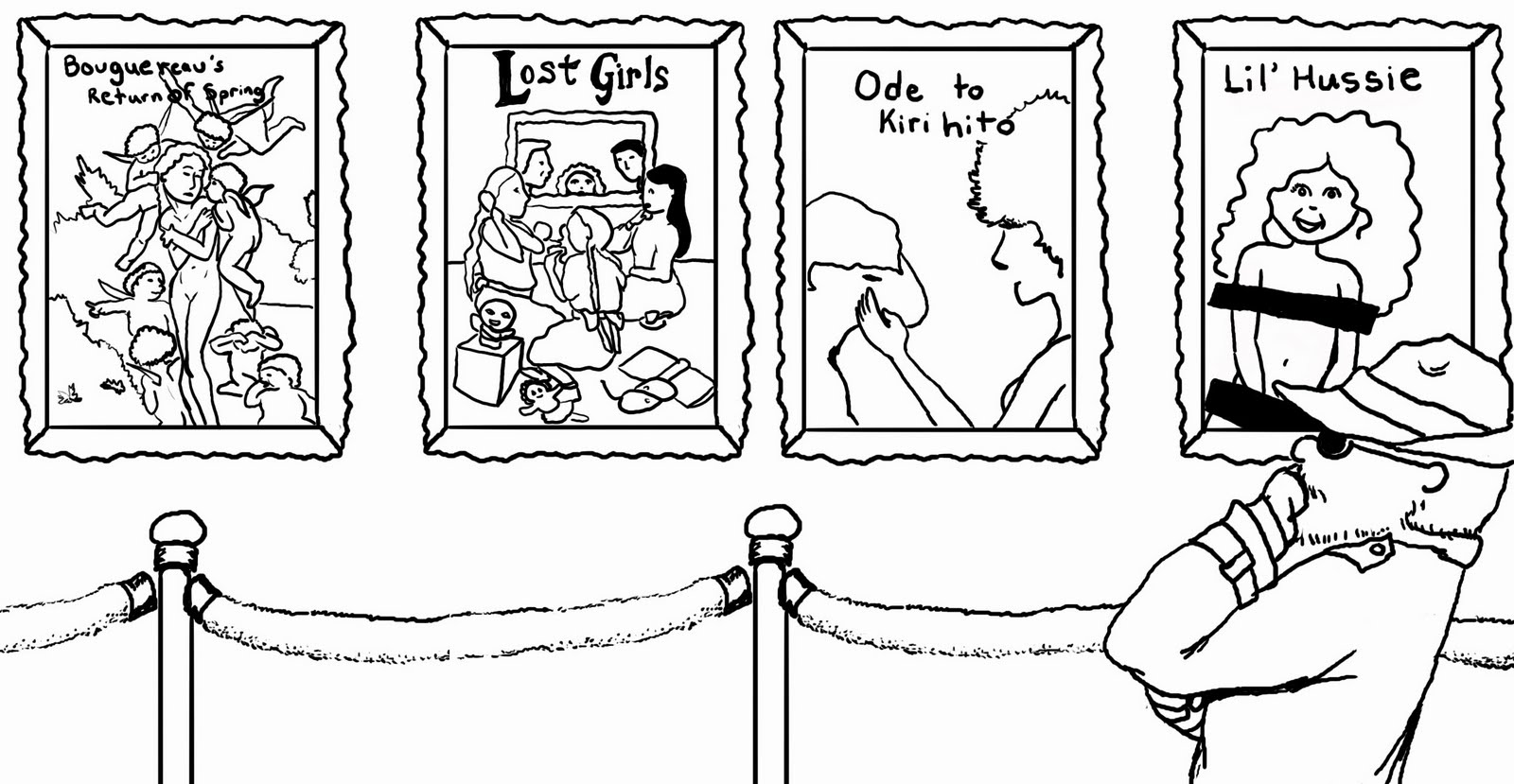
One of the seminal pieces of graphic literature in the 20th century is the Sandman series. The character of Delirium is depicted as being grade school age and often wears clothes that expose her bare chest. Is that considered child pornography?Osamu Tezuka's Ode To Kirihito, widely considered to be the first medical thriller in manga and certainly influential, is filled with explicit female nudity. Because of the artistic style and because age often is not mentioned, someone could easily identify the illustrations as being of minors.
Oh, but let's go further, what about nude baby pictures? Illustrated medical books? Sex Education highschool textbooks?
But I think the above examples are going to be pretty safe. Let's step towards the grey area, shall we?
Let's look at Lost Girls.
Alan Moore is basically THE creative powerhouse in the world of graphic literature. Chances are that if you're even a passive fan of graphic novels, you're aware of his name and his impact on the medium.
Lost Girls is something Mr. Moore himself describes as being pornography. To be clear however, his stated intent in defining the work in such a way is not to belittle the content but to elevate what adult material can be. For those not aware, the story of Lost Girls follows Dorothy Gale, Wendy Darling and Alice meeting and sharing the sexual exploits of their younger (most certainly underage) years in retellings of their respective familiar tales.The work contrasts their sexual exploits with the growing violence of the oncoming first world war. Much like Lady Chatterly's Lover, which set a passionate affair between an upper class married woman and a servant against a backdrop of class struggles, Lost Girls has a much richer thematic tapestry than it's plot summary would suggest.
To say that such a work has no literary value is absurd, yet I've little doubt this book would fall under Canada's definition of child pornography.
The reality is that sexuallity isn't something that just switches on at eighteen. And a person's sexual awakening is usually one of the most powerful and profound events in their lives. A first lover may stay in your mind longer than any other. The first dance, the first kiss, the first moment of shared intimacy; these are rites of passage that resonate with everyone regardless of ethicity or background. And often it's against the background of those profoundly affecting events that the strongest stories are told.
It's for that very reason that this report disturbs me.
If as a society we're unwilling to tolerate exploration of something so fundamentally human in art and graphic storytelling, then what does that say about us?
Yes, Japan is known for some pretty messed up stuff particularly in the depiction of sexuality. Yet, ironically, images of explicit sexual activities and frontal nudity were banned well into the 1980s. And rather than leading an increase, a late 1990s study found a marked decrease in sex crime across all demographics since the that ban was lifted. To quote: It is certainly clear from our data and analysis that a massive increase in available pornography in Japan has been correlated with a dramatic decrease in sexual crimes and most so among youngsters as ... victims.
But there's more at stake here, I think; if we're not willing to take a stand for the freedom of artistic expression when it challenges something we may not agree with then what right do we have to do so when it happens to be something that DOES matter to us?
Until next time, I'm the Trenchcoat Anti-Critic... and I need a shower after this.
ONE FINAL THOUGHT
In most of North America the legal age of consent is 16. Two teenagers can legally get together and screw each other's brains out on their sweet sixteen party, but God help that same couple if they engage in 'sexting'; even between a legally consenting couple, possessing a photo of a lover's exposed underage breast is a felony.
ILLUSTRATION BY BETH WAGNER
Labels:
Child pornography,
comics,
I could get arrested,
illegal,
legality,
sex
Saturday, June 18, 2011
An Interview
I'm working on something kind of cool that's eating up my time right now, so no new article this week. Instead, well, somebody interviewed me! If you follow the facebook page, this'll be nothing new, but for those who don't; enjoy!
Labels:
interview,
the film renegado,
Trenchcoat Anti-Critic
Wednesday, June 8, 2011
Spoon Feeding Canadian Nationality
I love films. There's little I enjoy more than curling up with a decent movie and spending an evening swept away by a film-maker's skillful execution of a story. Very frequently I'll find myself on the opposite side of popular opinion on a movie (particularly genre entries, for some reason).
The much maligned Freddy's Dead is among my favorites of the series. Up there too is Aliens Vs. Predator. Extreme examples, of course, but I stand by them.
And conversely there are a few things which irritate me to no end that go by unnoticed by most others.
Chief among these is something I'm going to call Mandated Nationality. I won't be so conceited as to say this only happens in Canada, but it's the occurrences in Canadian productions which irk me.
Mandated Nationality happens when a Canadian film's financing depends on government grants. See, in order to qualify for these Grants, productions need to prove how Canadian they are. Influence from this ranges from requiring a percentage of key positions being Canadian to the numbers of Canadian flags needing to appear.
In the States, the process to make a movie goes like this: a producer pitches a story to people with money and convinces them to invest based on the strength of that story. It could be about a Tibeten spiritual leader, or an Indian revolutionary, or even a Russian submarine and it'd have a genuine chance of selling.*
I understand it. Honest.
Films from Canada have to compete directly with films from Hollywood. Add to the mix our lower budgets, smaller population, and shared language and it's little wonder the vast majority of Canadian films don't even break even, let alone make a profit.
So with profit realistically taken out of the equation, the motivation for funding films for organizations becomes about 'preserving cultural identity'. Or 'exploring the Canadian experience'. That translates to ensuring the stories that are told are Canadian stories; often filled to the gills with Canadian iconography.
But here's the thing; Canadians aren't interested in CANADIAN stories, they're interested in HUMAN stories.
Time for examples.
CASE STUDY - 'BON COP, BAD COP'
The idea of having a Quebec cop and an Ontario cop forced to work together is actually a clever idea. The situation is both uniquely Canadian, yet stems from human interaction. It allows the film to have a lot of interesting undercurrents related to the political and social differences between English and French Canadian cultures.But then... the villain.
For those who haven't seen this film I'm not going to spoil it, but the villain and much of the plot revolves around something so ridiculous that it could only have come out of a bunch of people going "How can we make this movie about Ontario and Quebec detectives MORE Canadian?".
An otherwise fun film.
CASE STUDY - 'SCORE'
Hockey. The Musical. Ugh...Bubble gum songs (with no lyricist) and a plot straight out of the 1950's musical era. This seems more of a joke of what a Canadian musical would be than a real movie, but it's played straight.
This is the only film on this list I have not seen.
CASE STUDY - 'ONE WEEK'
This is a story about a man who goes on a road trip across the country after learning he had cancer and the lives he touches on his journey.Well, in theory.
The issue I have with this film, directed by Michael McGowan (who was also behind Score), is that the character arc doesn't ring true to me. Ultimately he's running away from his problems, and beyond deciding to undergo treatment he doesn't fundamentally change.
A better way to put it is that the whole story feels shoe-horned in as an excuse to show as many Canadian landmarks as possible. And what qualifies as a Canadian landmark? A really big chair, some statues and the Stanley Cup. It doesn't really compare with Mount Rushmore as far as iconography goes.
This movie too I'll admit to being overly harsh on. The whole thing is scored with some great tunes, it's inventive, and the narration is reminiscent of Pushing Daisies or Amalie. It is actually really enjoyable.
None of that changes how much it pisses me off, of course.
CLOSING THOUGHTS
The truly ironic thing is that these movies make such an effort to be Canadian that they end up representing little more than a steriotype of the country; they offer empty platitudes rather than saying anything new or meaningful about the Canadian experience.
It's not like movies about Canadians can't be good. Both Shake Hands With The Devil and Scott Pilgrim trump any doubts about either the variety or quality potential of our stories.
And Canadian films don't consist exclusively of Bureaucratic compromizes. Despite the hurdles, the Canadian arthouse scene is actually considered one of the most exciting in the world right now. Directors like Atom Egoyan, Guy Madden, and Deepa Metha are continuing to win near universal accolades.
And the mainstream is certainly not without quality productions, either. Films like Suck, Pachendale, and A Simple Curve are proof enough of that.
In other words, it can be done.
Until next time, I'm the Trenchcoat Anti-Critic.
NOTE: It needs to be mentioned that this article is strictly refering to English speaking Canada. Quebec has a thriving and self-contained film industry. That's a topic for another day.
*Kundun, Gandhi, and K19: The Widowmaker respectively.
Labels:
art,
bon cop bad cop,
bureaucracy,
canada,
film,
One week,
score,
Trenchcoat Anti-Critic
Friday, June 3, 2011
Westboro Babtist Church
At this point, I think everyone is at least somewhat familiar with the controversial Westboro Babtist Church. For those who don't know them by name, you know those people holding multiple billboards reading "GOD HATES FAGS" and "THANK GOD FOR DEAD SOLDIERS"? Them.
According to wikipedia the church, which is very small I might add, spents upwards of $200,000 on travel expences in their cross-continent protesting quest at the highest profile events they can muster.
Honestly, I have a grudging respect for how effective they are at viral marketting. They've gotten millions of dollars of 'free' exposure on the news, had multiple high-profile documentaries made about them, and have become a household name to many lgbt rights activists.
The church, though it qualifies as a non-profit organization under US law, has landed on several lists of known hate organizations.
Which makes it all the more surprising when little over a week ago the Knights of the Southern Cross, a Virginian chapter of the notorious Klu Klux Klan, showed up to counter-protest the WBC's latest attention grab at the funeral of a US soldier. The organizer of the KKK's presence, a veteran himself, felt the WBC's protests at soldier funerals were deeply disrespectful.
More surprising is that the Westboro Babtist Church, which has labeled Barack Obama the Anti-Christ and have compared jewish people en mass to Nazis, claim to have nothing against people of other race. In fact, the churches founder, Fred Phelps, reportedly was involved in the civil rights movement of the '60s.
Remember when it was easy to tell who the bad guys were?
Until next time, I'm the Trenchcoat Anti-Critic.
According to wikipedia the church, which is very small I might add, spents upwards of $200,000 on travel expences in their cross-continent protesting quest at the highest profile events they can muster.
Honestly, I have a grudging respect for how effective they are at viral marketting. They've gotten millions of dollars of 'free' exposure on the news, had multiple high-profile documentaries made about them, and have become a household name to many lgbt rights activists.
The church, though it qualifies as a non-profit organization under US law, has landed on several lists of known hate organizations.
Which makes it all the more surprising when little over a week ago the Knights of the Southern Cross, a Virginian chapter of the notorious Klu Klux Klan, showed up to counter-protest the WBC's latest attention grab at the funeral of a US soldier. The organizer of the KKK's presence, a veteran himself, felt the WBC's protests at soldier funerals were deeply disrespectful.
More surprising is that the Westboro Babtist Church, which has labeled Barack Obama the Anti-Christ and have compared jewish people en mass to Nazis, claim to have nothing against people of other race. In fact, the churches founder, Fred Phelps, reportedly was involved in the civil rights movement of the '60s.
Remember when it was easy to tell who the bad guys were?
Until next time, I'm the Trenchcoat Anti-Critic.
Labels:
kkk,
klu klux klan,
protest,
wbc,
westboro babtist church
Thursday, May 26, 2011
Thoughts and Musings on a Post-Apocalyptic Japan
There's cruel irony that all this is happening to a country that not only had the horrors of Hiroshima and Nagasaki, but whose cinema seems to come back again and again to the destruction of society.
They created Godzilla, a creature created in nuclear tests. Godzilla, even in the incarnations where he's on humanity's side, never fails to levels cities on his every visit. The King of the Monsters is far from the only monster, of course. From Kaiju to Sentai there are entire genres centered around forces destroying Japan.
Not to mention that seemingly a third of all anime takes place after a good part of the world has been destroyed and rebuilt. Akira. Neon Genesis Evangelion. Wolf's Rain. You could probably list a dozen more without breaking a sweat.
Those repeated themes are no coincidence. Japan fought the second world war on the losing side. The aftermath of which saw the existing Japanese culture shaken to it's core. They rebuilt from the ground up.
That sounds pretty post-apocalyptic to me.
Compare that to the United States, whose cinema frequently employs stories of the common man triumphing against great adversity. This in a country that earned its independence in a hard won victory against the better equipped and more experienced British army.
Repeated themes and motifs in a culture's film and art is not unique to Japan or America, of course. Spain's cinema frequently has death playing a large role in people's lives, and not in a negative way. Canada's films frequently explore the nature of communication. Many Russian filmmakers contrast restraint against chaos, echoing the aftermath of Communism.
I'm simplifying, but the fact remains that massive cultural events shape cinema and art. It's one of the ways people can digest and process cultural shifts. And Japan is in the midst of one hell of a cultural shift right now.
There's nothing that should belittle the challenges ahead for the people of Japan, but this will pass. And once the dust settles, it'll be time for the artists and filmmakers of the country to explore the meaning of life in the new Japan.
The Carlin-joke disaster is coming to it's conclusion, finally. Soon comes the time for Japan to rebuild again. What shape will it be, this time? What shape will it's art take?
My prayers to those still suffering in Japan. My thoughts to the future.
Until next time, I'm the Trenchcoat Anti-Critic.
UPDATE: This is Long Overdue
I have been, frankly, irresponsible with this blog. My intent was always was to use this as a place where I could share my thoughts and musings on film, not to have it sit idle for months at a time. And not just as a place to post the videos I do. It's not fair to anyone who took the time to subscribe.
The Trenchcoat video series has been on a bit of a hiatus since September while I worked on revamping it, but that has seen delay after delay and is actually going to be further delayed until August due to the loss of the location.
I have tried to continue to be active on facebook and twitter, but that doesn't excuse the lack of activity here.
Recently I joined the modern age with a Blackberry. With it I've found I've been using social networking more, and, as a result, I've been finding I again have things to express about film. But neither Facebook nor Twitter was made for waxing philosophical. Though I may continue to use both as a scrapbook for ideas, this will be where they should be fully-formed.
So I'm going to try this again.
Most future entries will be via Blackberry, which means shorter and with fewer pictures, but it should also mean more frequent. So fingers crossed.
Until next time, I'm the Trenchcoat Anti-Critic.
The Trenchcoat video series has been on a bit of a hiatus since September while I worked on revamping it, but that has seen delay after delay and is actually going to be further delayed until August due to the loss of the location.
I have tried to continue to be active on facebook and twitter, but that doesn't excuse the lack of activity here.
Recently I joined the modern age with a Blackberry. With it I've found I've been using social networking more, and, as a result, I've been finding I again have things to express about film. But neither Facebook nor Twitter was made for waxing philosophical. Though I may continue to use both as a scrapbook for ideas, this will be where they should be fully-formed.
So I'm going to try this again.
Most future entries will be via Blackberry, which means shorter and with fewer pictures, but it should also mean more frequent. So fingers crossed.
Until next time, I'm the Trenchcoat Anti-Critic.
Thursday, March 10, 2011
Trenchcoat Anti-Critic Presents: Riverdale Behind the Scenes - Day One
Hey guys! I had the chance to get on set of a massively popular viral video, Riverdale (a mock trailer). More videos coming soon from that, but for the time being I'm proud to present to you guys the behind the scenes of this great video!
Tuesday, February 15, 2011
KITCHEN LOGIC: Integrity
Ladies and gentlemen, a little something I've been working on for a while.
KITCHEN LOGIC (kich-uhn law-jick)
definition
1. That moment when you're preparing dinner and you suddenly realize that Indiana Jones could never have survived falling out of a plane in an inflatable dingy.
2. The podcast where high brow meets anarchy.
This Episode's Hosts:
-Kyle Kallgren
-Joshua Bell
-BD MacDonald
With Very Special Thanks to:
-Karen Demsko for additional voice work
-Gustavo Rodriguez for generously supplying music
KITCHEN LOGIC (kich-uhn law-jick)
definition
1. That moment when you're preparing dinner and you suddenly realize that Indiana Jones could never have survived falling out of a plane in an inflatable dingy.
2. The podcast where high brow meets anarchy.
This Episode's Hosts:
-Kyle Kallgren
-Joshua Bell
-BD MacDonald
With Very Special Thanks to:
-Karen Demsko for additional voice work
-Gustavo Rodriguez for generously supplying music
Labels:
2009 movies,
anarchy,
awesome,
high brow,
kitchen logic,
podcast,
xtreme network online
Monday, January 10, 2011
Saturday, September 18, 2010
Subscribe to:
Posts (Atom)